| J | K | Q |
| 0 | 0 | Doesn't change (same as what it was) |
| 0 | 1 | 0 |
| 1 | 0 | 1 |
| 1 | 1 | Toggles (opposite of what it was) |
| J (Input to gates) |
K (Input to gates) |
Q (Input to gates) |
D (Output from gates to D input of FF) |
| 0 | 0 | 0 | 0 |
| 0 | 0 | 1 | 1 |
| 0 | 1 | 0 | 0 |
| 0 | 1 | 1 | 0 |
| 1 | 0 | 0 | 1 |
| 1 | 0 | 1 | 1 |
| 1 | 1 | 0 | 1 |
| 1 | 1 | 1 | 0 |
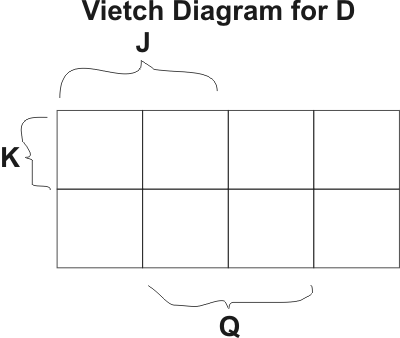
- Transfer information from the truth table to the Vietch Diagram for the D input of a D flip-flop.
- Use the Vietch Diagram to minimize the number of gates required.
- Write an equation for D in terms of J, K, and Q.
- Download a MultiSim file with a partial schematic.
- Add gates to the MultiSim file to implement the equation.
- Connect a four-channel Tektronix scope to the circuit to display J, K, D, and Q.

