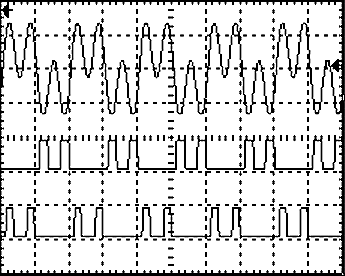
Oscilloscope Traces From Multisim Simulation
gj10-19 Blips to Period Converter
20 points
OEES 235
Oscilloscope Traces From Multisim Simulation |
| Above
is the oscilloscope display for a Multisim simuation of the tone
translator's analog
portion. The upper trace represents the signal
coming from the microphone. The second trace shows pulses for the times
when the microphone waveform has reached it's lowest points (negative
peaks). The third trace shows pulses for the positive peaks. (Sorry
that the second and third traces are reversed from what would be more
natural. I just noticed it at the last minute.) For this project, you'll design a circuit that will produce a square wave from the negative and positive peak signals (second and third traces). This square wave will have a frequency one octave lower than the frequency of the microphone waveform. In other words, the period of the square wave will be twice as long as the period of the microphone waveform. Our ears are able to tell when a waveform repeats itself, even it the waveform is quite complex. The microphone waveform as shown on the oscilloscope trace above has approximately five cycles, with each cycle being two squares wide. The square wave that our circuit would produce from the second and third traces would have a cycle that's four squares wide, or half the frequency. This won't be a problem because we'll have the digital octave shifter circuit shift the frequency back up one octave. This will give it the same frequency as the microphone waveform. (Of course, the musician will be able to press the octave-control buttons and shift the frequency up and down as desired.) |
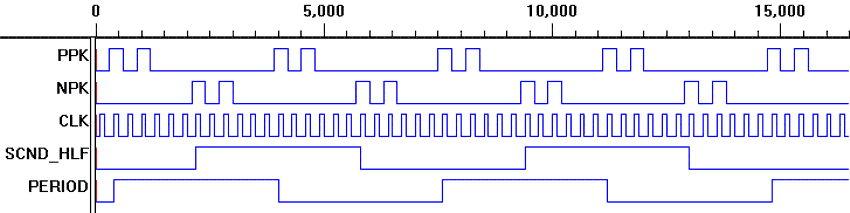 |
| The waveforms shown directly
above show how the digital circuitry for this project will achieve the
desired square wave. Here is the legend: Inputs to the Circuit: PPK = Positive peaks (similar to the third oscilloscope trace above). NPK = Negative peaks (similar to the second oscilloscope trace above). CLK = Clock Outputs From the Circuit: SCND_HLF = Second half of the waveform (roughly speaking) PERIOD = The desired square wave, which has a period twice as long as the waveform coming from the microphone. For this circuit, you'll need two clocked RS flip-flops. (These can be Lever's simplest RS flip-flops.) You'll also need four gates, with some of the inputs having inverting circles. See what you can come up with! Right-click here to get the test vector for this project. If you're curious, you can right-click here to get the Multisim file that produced the oscilloscope traces at the top of this Web page. |

